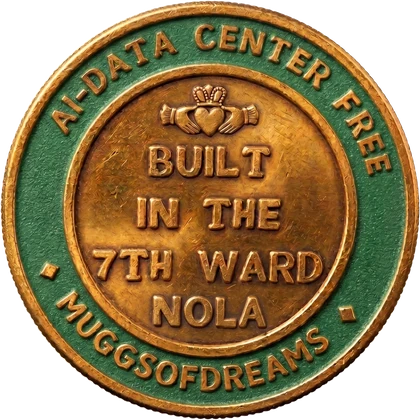
MUGGS OF DREAMS
ai-data center free. locally grown.
Building web presence for people and organizations that need to spend their money on what they do......not SquarePress.
muggsof.netcome see the neighborhoods
June 4, 2027
I'll be building as many pages as me and my tech stack can handle.
Building web presence for people and organizations that need to spend their money on what they do......not SquarePress.
7th ward, new orleans
my own page. i use the platform the same way you would.
mugg.muggsof.netOne shared address for every page. When a neighbor reaches out through your page, it lands in your inbox, and you can see it came through MuggsOf.
Each neighborhood gets its own events page, and muggsof.net shows which neighborhoods have something coming up. The only thing you need to post an event is a MuggsOf page.
Carey is a typeface made to honor Lester Carey, a New Orleans sign painter. His lettering is on churches, corner stores, neighborhood bars, and other buildings around New Orleans, and it's been there for three decades. The font is free for personal and commercial use, and released under the Open Font License. The typeface lives at lestercarey.com.
(Meet the tech stack and me)
AI doesn't have to live in a warehouse. Some AI models are released openly: you can download their files and run them on an ordinary, if powerful, home computer. That's called running a model locally.
MuggsOfDreams runs most of its AI locally. The pages are built at home and the art is made at home, with cloud AI helping for now.
The finished pages are hosted on Cloudflare (card 05), ordinary web hosting, not AI. Being 100% data-center free is the goal by launch day.
Where cloud AI still fits, and how it's leaving, is explained below in what is ai-data center free?.
A desktop in my house with an NVIDIA RTX 4090. On it runs Qwen 3.8 27B, an open model from Alibaba's Qwen team. The files are free to download, and it all runs on this machine.
It writes and edits code. It reads about 128,000 tokens at once, and a token is a piece of a word, so that's about 96,000 words, enough for a whole page plus its notes and the instructions. It looks at pictures, so it checks its own screenshots. And it thinks a problem through before it answers.
I chose it because it's strong at code for its size, it sees images, and it fits on one home graphics card, about 17 GB once compressed.
Its job: OpenCode (card 04) drives it. Qwen builds and edits every page from a written brief, runs the house checks, and ships. The checks are my words, every fact from the owner, the layout rules, even the spacing.
By launch it'll read a neighbor's form directly and offer a few options for each part, so I pick the one that fits.
A second desktop in my house, with an NVIDIA RTX 5070 Ti, joined to the builder by a cable straight between the two. Its one job is making images. It runs two open image models from Black Forest Labs.
FLUX.2 klein 4B redraws from pictures. It takes one of my photos plus a description and paints it new. That's how a photo of the block becomes a comic-book scene, the street, the telephone pole, the flyer on it. About 5 to 7 seconds a picture.
FLUX.1 schnell draws from words alone. Schnell is German for fast, four steps a picture.
Neither can be trusted to spell, so words in a scene, a sign or a name, are set afterward in the page's own Carey font.
I chose them for three reasons. The license, Apache 2.0, allows commercial use. They fit on the 5070 Ti. And they're fast enough to make a sheet of tries.
Its job: each page's doubloon and the comic-book scenes of the neighborhood. I pick every image myself, from the numbered sheet. One firm rule: art on a live page only comes from models whose licenses allow commercial use.
A model on its own just answers questions. To build something, it needs a workbench: a place to open files, write code, test it, and keep track of what's done. That's OpenCode, a free, open-source coding agent. It isn't locked to one AI company, so you can point it at any model, including one running on your own machine.
Here, OpenCode talks to Qwen (card 02). The bridge is LM Studio, a free app that downloads open models and runs them on your own computer. The open-source engine inside it is llama.cpp, the part that runs the model on an ordinary computer, including a home graphics card. LM Studio also hands the running model to other programs on the same machine, and that's how OpenCode reaches Qwen.
ComfyUI is open-source software for running image models. On the art shop (card 03), it's the program that runs them.
Before a page ships, Python scripts check it with Playwright, an open-source tool that opens the page in a browser and measures it.
The code lives on GitHub, which keeps it and every change ever made to it. There are two copies. One is private and has everything, notes, tools, briefs. The other has only the finished site.
Cloudflare puts that site-only copy on the web. muggsofdreams.net is published from it, and each yourname.muggsof.net page is served by a small Cloudflare program that also sends the contact emails ([email protected]).
This is ordinary web hosting, not AI. No model runs there. It's what keeps the pages fast for everyone.
I'm Sean, a computer science teacher in New Orleans. The machines do the typing, but I'm responsible for what goes live.
Every page is checked against the house rules before it ships. By launch, I'll be reading every form myself, choosing among the options the model offers, and keeping a record of those decisions. When something needs a human touch, it gets one. I'm not a graphic designer, and I'll tell you when it matters.
The best support is a new page on the map. Send me what you do, where you are, and how to find you.
start my pageKnow a thriving and/or striving entrepreneur? A cousin who's a popup caterer, a friend who paints, the barber down the street. Send them the link.
Optional and small. It goes straight to keeping this running.
buy me a coffeeMuggsOfDreams pages are built with AI that runs on computers in my house, with the assistance of cloud AI platforms that are run from data centers. Below is the honest version of how I plan to be able to build 100% AI-Data Center Free by launch day.
I am not a formally trained programmer or coder. If I was, this platform wouldn't be free.
I can map out complex projects, and research and discover the tools and resources to realize those projects. But I can't write code and handle super complex syntax.
So how does the codebase for the platform get created? Primarily and mostly with local models downloaded to and run from my personal hardware, powered by my own electricity bill.
Qwen 27B, the model I run on my 4090, can write Python. Where it falls short is the complex stuff: the tools and skills that have to work across lots of files at once. Those are just beyond what it can build reliably on its own. That's where I bring in cloud AI.
Specifically, Claude Opus 5.5, created by Anthropic and accessed through Claude Code. But I don't use Claude to write disposable, throwaway code. I use it to create durable tools and skills that the local models I use to build the platform need but cannot write on their own. Once they are created and working correctly, they can be used over and over again. And each time, I've inched closer to MuggsOfDreams becoming truly cloud AI independent.
That is how I intend to become AI-Data Center Free by official launch day. Every time I use it moves me closer to using it less.
Early neighbors, friends, and family letting me build them pages so I can build out the platform do so knowing that cloud AI is still involved in the building, so their data is exposed to AI data centers. But they also know that their page builds move the entire building process away from needing cloud AI.
No.
I want a space where anyone in New Orleans can start building their presence on the internet. Young entrepreneurs, artists, small business owners, writers, musicians. The established and the unestablished. Those with great websites, and those whose website is the rock in their shoe: it's built, it's there, and they try not to think about it.
Because they don't have time to deal with it.
Don't need a muggsof.net page? Great. I hope you get one anyway. So many people in this city are building their dreams from scratch, and I don't want to ask them to help me build this platform from scratch too.
What I want is a platform already full of pages when they arrive. A vibrant community that already exists, waiting for them to join.
tear off a slip.
curious? send me a note and i will write back.
ready? move in: fill out your page from top to bottom, and i build it.
i'm ready to move in. build me a page
know a bulletin board? print the flyer